
A recent report published by
Infinium Global Research on wireless connectivity market provides in-depth
analysis of segments and sub-segments in the global as well as regional
wireless connectivity market. The study also highlights the impact of drivers,
restraints, and macro indicators on the global and regional wireless
connectivity market over the short term as well as long term. The report is a
comprehensive presentation of trends, forecasts, and dollar values of global
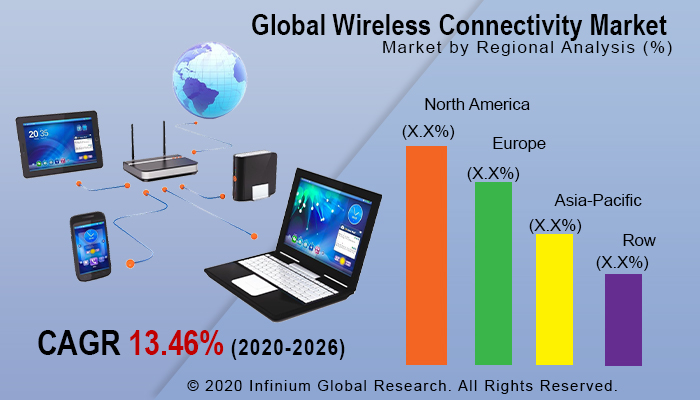
wireless connectivity market. According to the report, the global wireless
connectivity market is projected to grow at a CAGR of 13.46% over the forecast
period of 2020-2026.
Wireless connectivity for voice
calls has created an entirely new industry. Wireless connectivity is a network
of flexible data communication systems, which minimizes the need for wired
connections. Wireless connectivity uses electromagnetic waves to communicate
information. The world has increasingly become mobile over the past decade. The
traditional connectivity technologies have proven inadequate to meet the
challenges posed by our new collective lifestyle. Wireless connectivity allows
more free movement on the part of the network user. As a result, wireless
technologies are gaining popularity over traditional wired networks.
The OEMs integrate the wireless
connectivity components in their devices such as smartphones, tablets, laptops,
modems, and routers. The OEMs are facing several challenges during the COVID-19
pandemic. The governments in several countries have imposed lockdown orders,
restricting the business functions of various organizations to control the
pandemic. This has reduced or even stopped the production of wireless devices
in several countries. Furthermore, the demand for wireless devices and other
electronic products have declined in the period of COVID19. This is mainly due
to the growing economic uncertainty in several developing as well as developed
economies. However, the ease of government restrictions and monetary supply by
the government to boost the economy is expected to boost the manufacturing of
wireless devices. The growing adoption of wireless connecting devices and the
Internet of Things is driving the growth of the wireless connectivity market.
IoT uses sensors and connects devices to the internet through wireless
connectivity for information exchange and communications, in order to achieve
intelligent recognition, location, tracking, monitoring, and management.
Furthermore, the increasing penetration of the internet and smartphones is
another major growth driver for the wireless connectivity market. Smartphones
use different types of wireless connectivity technologies to access the
internet and to collect and share data. However, the high power consumption by
wireless sensors and connected devices is a major restraining factor that will
likely affect their adoption, and in turn, the growth of the market. Energy
consumption of connected and the sensors can be greater than the energy consumption
of other electronic components or even greater than the energy consumption of
the whole system. Moreover, rapid technological advancement in 5G technology is
providing significant growth opportunities for the market.
Asia-Pacific generated the largest
revenue in the global wireless connectivity market. Moreover, Asia-Pacific is
expected to grow at the fastest rate over the forecast period. The Asia-Pacific
market is largely driven by technological advancements and internet penetration
rates in developing economies, such as China and India. Furthermore, the rise
in the inclination of consumers toward advanced technological products is
likely to boost the wireless connectivity market in this region in the near
future.
The report on the global wireless
connectivity market covers segments such as application, and technology. On the
basis of application, the sub-markets include healthcare, wearable devices,
automotive and transportation, and consumer electronics. On the basis of
technology, the sub-markets include wifi, bluetooth, nfc, zigbee, enocean,
cellular technologies, and others.
The report provides profiles of
the companies in the market such as Intel Corporation, Texas Instruments
Incorporated, Qualcomm Incorporated, STMicroelectronics N.V, NXP Semiconductors
N.V, Microchip Technology Inc., Renesas Electronics Corporation, Skyworks
Solutions, Murata Manufacturing Co, and Infineon Technologies AG.
The report provides deep insights
into the demand forecasts, market trends, and micro and macro indicators. In
addition, this report provides insights into the factors that are driving and
restraining the growth in this market. Moreover, The IGR-Growth Matrix analysis
given in the report brings an insight into the investment areas that existing
or new market players can consider. The report provides insights into the market
using analytical tools such as Porter's five forces analysis and DRO analysis
of the wireless connectivity market. Moreover, the study highlights current market
trends and provides forecasts from 2020-2026. We also have highlighted future
trends in the market that will affect the demand during the forecast period.
Moreover, the competitive analysis given in each regional market brings an
insight into the market share of the leading players.