
A recent report published by Infinium Global Research on spinal
cord neurostimulation implant market provides an in-depth analysis of segments and
sub-segments in the global as well as regional spinal cord neurostimulation
implant market. The study also highlights the impact of drivers, restraints,
and macro indicators on the global and regional spinal cord neurostimulation
implant market over the short term as well as long term. The report is a
comprehensive presentation of trends, forecast and dollar values of the global
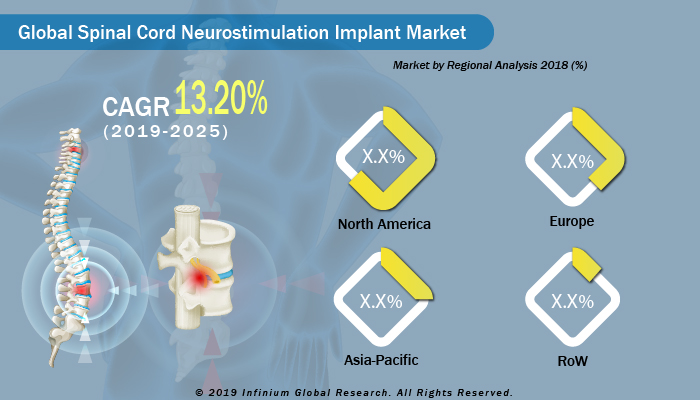
spinal cord neurostimulation implant market. According to the report, the
global spinal cord neurostimulation implant market is projected to grow at a
CAGR of 13.20% over the forecast period of 2019-2025.
The spinal cord neurostimulation implant market is expected to grow
with a healthy rate in the near future. The adoption of new advanced pain
management systems in developed countries is contributing to the growth of the
market. Chronic pain affects human life in the day to day activities, the
nature of the pain gets worse due to its long-lasting nature and unusual
recovery time. For example, a pathological pain after spinal cord surgery is
not a result of ongoing surgery and is therefore treated as a condition and not
as a symptom. It can prevent people from working, eating properly or
participating in physical activity. Spinal cord stimulation (SCS) is a
pain-relief technique that stimulates a low-voltage electrical current
constantly to the spinal cord that blocks the sensation of pain. SCS is FDA
approved medical treatment. With its wide acceptance around 50000
neurostimulators are implanted worldwide every year.
Increasing the incidence of spinal cord injuries, chronic back pain, and neurological disorder are the major factors driving the growth of the spinal
cord neurostimulation implant market. Data provided by WHO states that around
between 250,000 and 500,000 people suffer from spinal cord injury (SCI) every
year. Moreover, the growing adoption of advanced pain management systems is
another growth factor for the spinal cord neurostimulation implant market.
Dealing with the chronic pain with the conventional medicines for the patient
suffering from chronic leg and back pain is a difficult task, while the recent
studies state the effectivity of spinal cord neurostimulation implant for the
long term pain management over the conventional treatments. On the other hand,
the high cost associated with the devices and their timely maintenance can
hamper the growth of the market. However, increasing awareness among the people
and improvement in the reimbursement policies can provide better opportunities
for the market.
Geographically, the spinal cord neurostimulation implant market
segmented into North America, Europe, Asia-Pacific, and RoW. North America
especially the U.S. holds the largest share of the market and expected to stay
dominant over the forecast period, followed by Europe. Advanced healthcare
facilities and increasing funding for research and development are and
well-established reimbursement policies are supporting the growth of the market
in these regions. The market in Asia-Pacific is expected to grow with a steady
rate, high cost of the treatment and unsupportive reimbursement policies
causing the slow growth of the market.
The report on the global spinal cord neurostimulation implant market
covers segments such as SCS systems, lead type, applications, and end user. On
the basis of SCS systems, the sub-markets include conventional system,
radiofrequency system, and rechargeable system. On the basis of lead type, the
sub-markets include paddle leads, and cylindrical leads. On the basis of
applications, the sub-markets include sciatica, degenerative disk disease (DDD),
failed back surgery syndrome (FBS), and other applications. On the basis of end
user, the sub-markets include hospitals, physiotherapy centers, ambulatory
surgical centers, and other end users.
The report provides profiles of the companies in the market such
as Boston Scientific Corporation, Medtronic, Inc., Nevro Corporation,
Neurosigma, Inc., Neuropace, Inc., St. Jude Medical Inc., Aleva
Neurotherapeutics SA, Synapse Biomedical, Inc., Neuronetics, Inc., Cyberonics,
Inc., and Other companies.
The report provides deep insights into the demand forecasts,
market trends, and micro and macro indicators. In addition, this report
provides insights into the factors that are driving and restraining the growth
in this market. Moreover, The IGR-Growth Matrix analysis given in the report
brings an insight into the investment areas that existing or new market players
can consider. The report provides insights into the market using analytical
tools such as Porter's five forces analysis and DRO analysis of spinal cord
neurostimulation implant market. Moreover, the study highlights current market
trends and provides forecast from 2019-2025. We also have highlighted future
trends in the market that will affect the demand during the forecast period.
Moreover, the competitive analysis given in each regional market brings an
insight into the market share of the leading players.