
A recent report published by
Infinium Global Research on the smart retail devices market provides in-depth
analysis of segments and sub-segments in the global as well as regional smart
retail devices market. The study also highlights the impact of drivers,
restraints, and macro indicators on the global and regional smart retail
devices market over the short term as well as long term. The report is a
comprehensive presentation of trends, forecast and dollar values of the global
smart retail devices market. According to the report, the global smart retail
devices market is projected to grow at a CAGR of 6.43% over the forecast period
of 2021-2027.
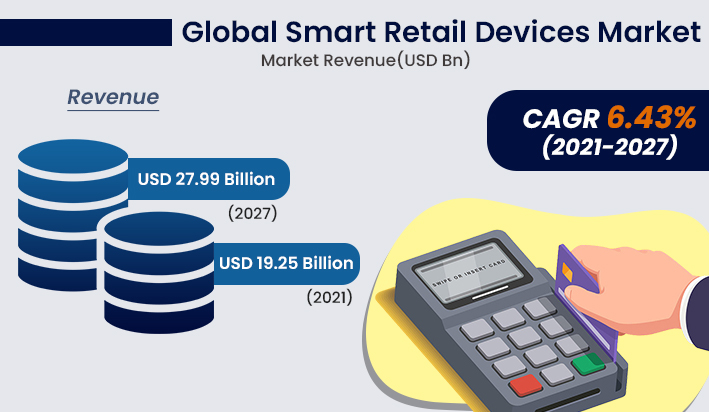
The smart retail devices market
was valued at USD 18.35 billion in 2020 and is expected to reach USD 27.99
billion in 2027, growing with a CAGR of 6.43% during the forecast period.
Retail stores are focusing on utilizing the developing technologies, for
instance, cloud, mobile, RFID, beacons, and others, to offer connected retail
services and a better shopping experience to consumers. For instance, store
proprietors are integrating sensors in the main zones of retail stores and
connecting them to the cloud via a gateway that permits real-time data analysis
associated with products, sales, and customers from the sensors. Furthermore,
smart devices and IoT in retail help retailers augment the customer experience and
propel more enhanced customer engagement which considerably alters the
day-to-day store operations.
The increasing usage of robotics
and automation in the retail industry and increasing adoption of big data
analytics & IoT in the retail industry boosts the smart retail devices
market. Moreover, a surge in purchasing power of consumers and economic growth
is the major drivers considerably affecting the smart retail devices market
growth in the near future. On the other hand, augmented maintenance costs of
advanced high-end computing systems and high risks of consumer data thefts have
a significant negative impact on the smart retail devices market growth.
Additionally, technological advancements with real-time data analysis and a
rise in the number of smart stores are anticipated to offer lucrative smart
retail devices market opportunities worldwide.
Among the geographies, the North
American region is expected to hold the largest share in the global smart
retail devices market owing to the growing retail industry across the region.
The United States and Canada are anticipated to be the major revenue
contributors in the North American smart retail devices market. Furthermore,
the Asia Pacific region is projected to grow at the fastest rate in the global
smart retail devices market during the projection period, owing to its growing
industrialization across the region. Additionally, increasing deployment of
smart retail solutions such as big data analytics, intelligent dressing
mirrors, reception robots, and shopping guide robots in countries such as Japan
and China is anticipated to drive the smart retail devices market in Asia
Pacific region.
The report on global smart retail
devices market covers segments such as technology, and application. On the
basis of technology, the sub-markets include digital signage, smart labels,
smart payments, smart carts, electronic shelf labels, and others. On the basis
of application, the sub-markets include smart transportation, predictive
equipment maintenance, inventory management, smart fitting room, foot traffic
monitoring, and others.
The report provides profiles of
the companies in the market such as Intel, Cisco, IBM, NXP Semiconductors,
Microsoft Corporation, NVIDIA Corporation, Samsung Electronics, Texas
Instrument, Softbank Robotics, and PAX Global Technology.
The report provides deep insights
into the demand forecasts, market trends, and micro and macro indicators. In
addition, this report provides insights into the factors that are driving and
restraining the growth in this market. Moreover, The IGR-Growth Matrix analysis
given in the report brings an insight into the investment areas that existing
or new market players can consider. The report provides insights into the
market using analytical tools such as Porter's five forces analysis and DRO
analysis of the smart retail devices market. Moreover, the study highlights current
market trends and provides forecast from 2021-2027. We also have highlighted
future trends in the market that will affect the demand during the forecast
period. Moreover, the competitive analysis given in each regional market brings
an insight into the market share of the leading players.