
A recent report published by Infinium Global Research on the smart
greenhouse market provides an in-depth analysis of segments and sub-segments in
the global as well as regional smart greenhouse market. The study also
highlights the impact of drivers, restraints, and macro indicators on the
global and regional smart greenhouse market over the short term as well as long
term. The report is a comprehensive presentation of trends, forecasts, and dollar
values of the global smart greenhouse market. According to the report, the global
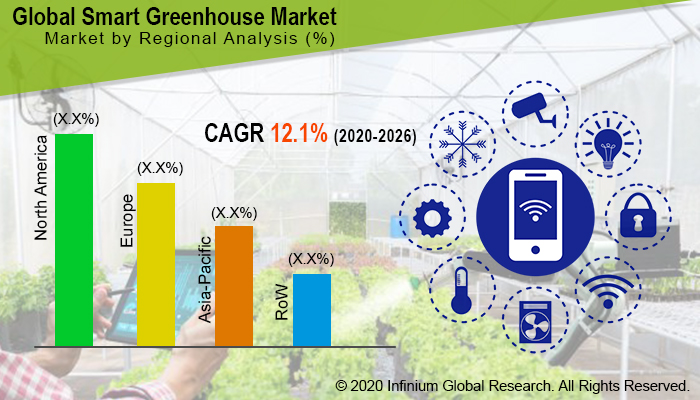
smart greenhouse market is projected to grow at a CAGR of 12.1% over the
forecast period of 2020-2026.
Greenhouse, an urban farming method, delivers farmers with a
preference to provide optimum cultivation conditions by proposing a controlled
environment according to the crop’s requirements. The smart greenhouse is a
self-regulating and self-monitoring, micro-climatically controlled, for
example, temperature, humidity, luminosity, soil moisture environment for ideal
plant growth. Even slight differences in these conditions generate automated
actions that estimate change and take corrective action and therefore,
maintaining ideal conditions for plant growth.
The increased reliability in the smart greenhouse along with the
increasing energy demand from the emerging economies is acting as drivers for
the growth of the smart greenhouse market. However, a smart greenhouse requires
a high investment, has a complex process as well as involves high risk which is
detaining the market from growing at a higher pace. With the progression of
technological advancements comes the usage of artificial intelligence devices, control
devices, and sensors that permits automation in greenhouse agriculture. The
high demand for food due to the ever-growing population, trend of indoor
farming, government initiatives and incentives involving to smart greenhouse
lighting technology contribute substantially towards the development of the
smart greenhouse market across the globe. Conversely, the integration of
technologies and the requirement of high initial investment are considered a
few of the key factors projected to restrict the growth of the global smart greenhouse
in the near future. The on-going health crisis around COVID-19 has affected all
walks of life. Protecting the lives of people suffering from the disease as
well as frontline health responders have been the priority of nations.
Governments have swung into actions since the Coronavirus attack created an
unprecedented situation. To sustain the demand for agricultural commodities,
investments in key logistics must be enhanced. Moreover, e-commerce and
delivery companies and start-ups need to be encouraged with suitable policies
and incentives. The small and medium enterprises, running with raw materials
from the agriculture and allied sector or otherwise, also need special
attention so that the rural economy doesn’t collapse.
Among the geographies, North America region is expected to hold
the largest share in the global smart greenhouse market as countries such as
the U.S. and Canada are the front-runners of the adoption of new farming
techniques such as precision agriculture, vertical farming, and indoor farming,
among others. Further, factors such as growing urbanization and food demand
have accelerated the growth of the smart greenhouse market in the North
American region. Moreover, the Asia Pacific region is expected to witness high
growth during the forecast period owing to the growing government support and
rising awareness among cultivators. Countries such as China and Japan are
projected to witness considerable growth in the upcoming years owing to the
presence of a large number of indoor farms.
The report on the global smart greenhouse market covers segments such
as type, component, and end user. On the basis of type, the sub-markets include
hydroponic, and non-hydroponic. On the basis of component, the sub-markets
include HVAC systems, LED grow lights, irrigation system, valves & pumps,
sensor & control system, and others. On the basis of end user, the
sub-markets include commercial growers, research & educational institutes,
retail gardens, and others.
The report provides profiles of the companies in the market such
as Greentech Agro LLC, Heliospectra AB, Argus Controls, Certhon Group, Cultivar
SA, Hort Americas LLC, Sensaphone, LumiGrow, Inc., Netafim Irrigation Inc., and
Rough Brothers.
The report provides deep insights into the demand forecasts,
market trends, and micro and macro indicators. In addition, this report
provides insights into the factors that are driving and restraining the growth
in this market. Moreover, The IGR-Growth Matrix analysis given in the report
brings an insight into the investment areas that existing or new market players
can consider. The report provides insights into the market using analytical
tools such as Porter's five forces analysis and DRO analysis of the smart
greenhouse market. Moreover, the study highlights current market trends and
provides forecast from 2020-2026. We also have highlighted future trends in the
market that will affect the demand during the forecast period. Moreover, the
competitive analysis given in each regional market brings an insight into the
market share of the leading players.