
A recent report published by Infinium
Global Research on the smart biosensors market provides an in-depth analysis of
segments and sub-segments in the global as well as regional smart biosensors
market. The study also highlights the impact of drivers, restraints, and macro
indicators on the global and regional smart biosensors market over the short
term as well as long term. The report is a comprehensive presentation of
trends, forecast and dollar values of the global smart biosensors market. According
to the report, the global smart biosensors market is projected to grow at a
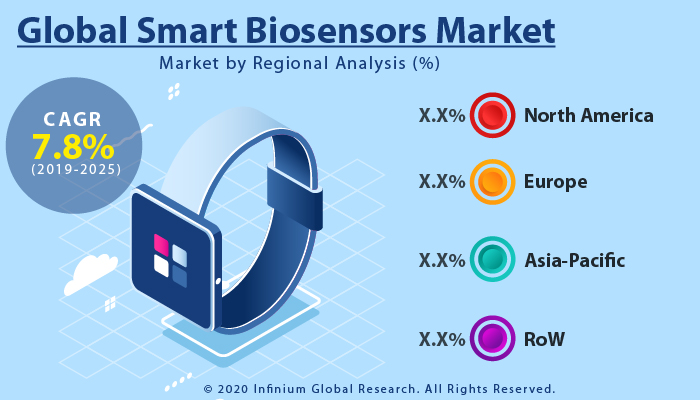
CAGR of 7.8% over the forecast period of 2019-2025.
Smart
biosensors are the advance version of the biosensor and provide more accurate
analytical signals as compared to signal provided by normal biosensors. These
smart biosensors use more highly selective and sensitive methods to provide
more accurate analytical signals for precise observation. The growing
automation in different industries such as food and beverage, medical,
clinical biochemistry, analytical chemistry, and environmental science research the industry is providing the growing demand for the smart biosensors market.
The
growing demand for the fast and precise analysis of the different types of food
products to identify the microorganism, chemical residue and others are helping
to grow the demand for smart biosensors in the food industry. Furthermore, the
growing demand for the advanced modern biosensor for a better analysis of the
different types of chemicals in the environment is helping to catalyze the
growth of this market. Moreover, innovations in the monitoring systems and
surge in R&D spending are driving the demand of smart biosensors market.
However, lack of infrastructure to support the smart biosensors in several
industries owing to several factors as owners’ unwillingness to replace the
conventional infrastructure, are affecting the growth of the market for the
short term. The growing government focus to replace traditional infrastructure
owing to several reasons as energy saving, environmental protection, and others
are expected to boost the demand of the smart biosensor in the near future.
North America holds the largest share for the smart biosensors market, owing to the presence of a number of companies engaged in the manufacturing of the smart the biosensor in this region, who are intensively engaged in the development of the the new and advanced biosensor in this region. The Asia-Pacific region is growing with a healthy CAGR for the smart biosensors market owing to the growing demand for smart biosensors for several applications.
The report on the global smart biosensors
market covers segments such as product type, technology, application, and end
user. On the basis of product type, the sub-markets include wearable
biosensors, and non-wearable biosensors. On the basis of technology, the
sub-markets include electrochemical biosensors, optical biosensors,
piezoelectric biosensors, nano mechanical biosensors, thermal biosensors, and
other technologies. On the basis of application, the sub-markets include blood
glucose testing, pregnancy testing, cholesterol testing, drug discovery, blood
gas analysis, infectious disease testing, and other applications. On the basis
of end user, the sub-markets include home diagnostics, environmental
monitoring, research labs, point-of-care, security and biodefense, food and
beverage industry, and other end-users.
The report provides profiles of the
companies in the market such as Abbott Point of Care Inc., Medtronic Inc., F.
Hoffman La-Roche Ltd., Siemens Healthcare AG, Lifescan, Inc., LifeSensors Inc.,
Nova Biomedical Corp., Acon Laboratories Inc., Universal Biosensors, and
Pharmaco-Kinesis Corporation.
The report provides deep insights into
the demand forecasts, market trends, and micro and macro indicators. In
addition, this report provides insights into the factors that are driving and
restraining the growth in this market. Moreover, The IGR-Growth Matrix analysis
given in the report brings an insight into the investment areas that existing or
new market players can consider. The report provides insights into the market
using analytical tools such as Porter's five forces analysis and DRO analysis
of the smart biosensors market. Moreover, the study highlights current market
trends and provides forecast from 2019-2025. We also have highlighted future
trends in the market that will affect the demand during the forecast period.
Moreover, the competitive analysis given in each regional market brings an
insight into the market share of the leading players.