
A recent report published by
Infinium Global Research on robot operating system market provides in-depth
analysis of segments and sub-segments in the global as well as regional robot
operating system market. The study also highlights the impact of drivers,
restraints, and macro indicators on the global and regional robot operating
system market over the short term as well as long term. The report is a
comprehensive presentation of trends, forecast and dollar values of the global
robot operating system market. According to the report, the global robot
operating system market is projected to grow at a CAGR of 9.2% over the
forecast period of 2021-2027.
The global robot operating system
market size to grow from USD 339.45 million in 2020 to USD 622.24 million by
2027, at a Compound Annual Growth Rate (CAGR) of 9.2% during the forecast
period. Robot Operating System (ROS) is a set of software libraries that helps
to build robot applications. This is a flexible framework for writing robot
software. The Robot Operating System has a deeper foothold in the robotics
industry. Since it was first developed in 2007, the open-source framework for
developing robotics software has found its way into various research projects
and has even been embraced by major robotics companies.
The growing adoption of robot
operating systems by major automotive manufacturers is driving the growth of
the market. In recent years, self-driving car research is becoming the main
direction for automotive companies. The companies like Baidu, Toyota, GE,
Tesla, Ford, BMW, Bosch, Google, Uber, and Volvo are investing in autonomous
driving research. The rapid development of autonomous vehicles has promoted a
large demand for autonomous cars engineers. Among the skills required, knowing
how to program with a robot operating system is becoming an important one. The
whole ROS system has been designed to be fully distributed in terms of
computation, and act together as a single entity. These characteristics, of
ROS, are a perfect tool for self-driving cars. An autonomous vehicle can be
considered as another type of robot, so the same types of programs are used to
control them. Furthermore, increasing implementation of collaborative modular
robots, the growing participation of SMEs in developing countries, and rising
R&D Funds for Industry Automation are the factors driving the growth of the
robot operating system market. However, the high Installation Cost of the robot
operating systems is affecting the growth of the market. Moreover, the rising
Adoption of Low-Cost Industrial Robots provides a significant growth
opportunity for the market.
The Asia Pacific dominates the
robot operating system market. Increasing demand for robot operating systems
from various end-users is driving the market growth in this region over the
forecast period. The number of registered ROS users is increasing rapidly in
emerging markets like China, Japan, South Korea, and Australia. In addition,
the ROS market in the Asia Pacific is expected to see growth owing to rapid
industrialization, safety prospects, improved quality & reliability.
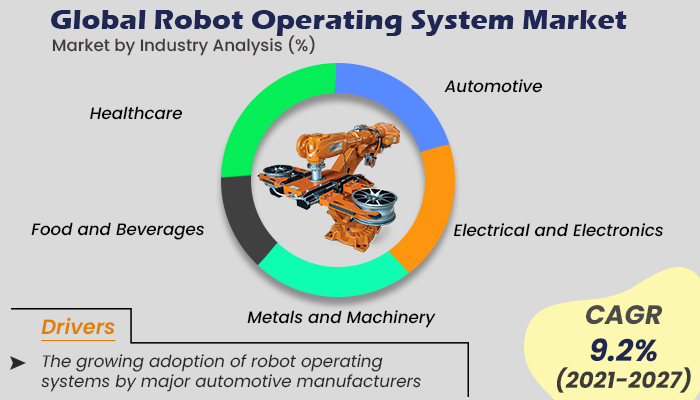
The report on the global robot
operating system market covers segments such as robot type, and industry. On
the basis of robot type, the sub-markets include articulated, SCARA, parallel,
cartesian, and collaborative. On the basis of industry, the sub-markets include
automotive, electrical and electronics, metals and machinery, food and
beverages, and healthcare.
The report provides profiles of
the companies in the market such as ABB Group, Omron Adept Technology, Yaskawa
Motoman, KUKA AG, Husarion Inc, Stanley Innovation, Clearpath Robots,
Cyberbotics Ltd, Rethink Robots, and Fanuc Corporation.
The report provides deep insights
into the demand forecasts, market trends, and micro and macro indicators. In
addition, this report provides insights into the factors that are driving and
restraining the growth in this market. Moreover, The IGR-Growth Matrix analysis
given in the report brings an insight into the investment areas that existing
or new market players can consider. The report provides insights into the
market using analytical tools such as Porter's five forces analysis and DRO
analysis of the robot operating system market. Moreover, the study highlights
current market trends and provides forecast from 2021-2027. We also have
highlighted future trends in the market that will affect the demand during the
forecast period. Moreover, the competitive analysis given in each regional
market brings an insight into the market share of the leading players.