
A recent report published by Infinium Global Research on the risk
analytics market provides an in-depth analysis of segments and sub-segments in the
global as well as regional risk analytics market. The study also highlights the
impact of drivers, restraints, and macro indicators on the global and regional
risk analytics market over the short term as well as long term. The report is a
comprehensive presentation of trends, forecasts, and dollar values of the global risk
analytics market. According to the report, the global risk analytics market is
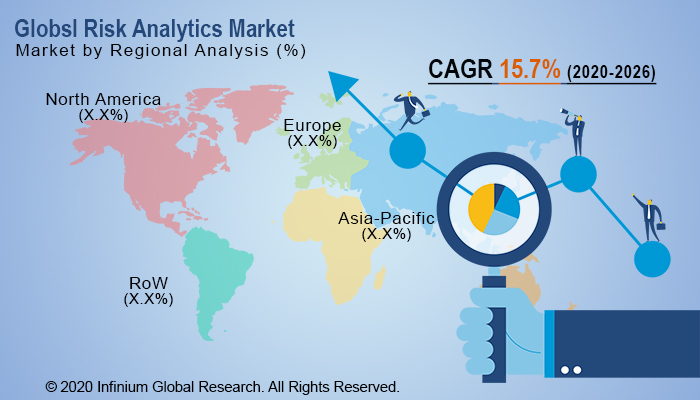
projected to grow at a CAGR of 15.7% over the forecast period of 2020-2026.
Risk analytics is the process by which the uncertainty of a
particular action is determined. For businesses, risk analysis is tremendously
crucial in order to be able to predict future negative situations that would
normally go unnoticed. Some negative unexpected situations that risk analytics
could predict are the cash flow streams in certain industries for businesses,
the possible economic states, or even the determination of whether a certain
project is expected to be successful. Together with this, a risk analytics tool
improves return on capital and reduces the cost involved in regulatory
compliance. With enterprises prospering to reduce catastrophic losses, the adoption of risk analytics tools has seen a revolutionary trend in recent years.
Additionally, risk analytics tools help in the central clearing of over-the-counter
(OTC) derivatives.
Factors that are boosting the risk analytics market growth are the
capacity for risk identification, fraud detection, the ability to use the
service in order to prevent risks or failures as well as real-time situational
awareness. The upsurge in numerous cyber-attacks, fraudulent attacks, and data
theft on different business owing to the on-going trend of digitization is the
major factors that drive the growth of the global market. The risk analytics
market trends comprise a rise in data security breaches in enterprises and an
increase in government regulatory compliances are some of the major factors
that are anticipated to drive the growth of the market. However, the
uncertainty of the accuracy of the information that is being provided through
the risk analysis as well as the time it takes in order to carry out the risk
analysis are the factors that are restraining the risk analysis market’s
growth. Additionally, the current concern over the spread of coronavirus is
also expected to have a positive impact on the risk analytics market.
Artificial Intelligence (AI) and Natural languages (NL) solutions are
anticipated to substantially contribute while responding to the COVID-19
pandemic and address continuously evolving challenges. The existing situation
owing to the outbreak of the epidemic will inspire vendors to improve their
R&D investments in analytics solutions, acting as a core technology for
enabling various initiatives. The analytics industry is expected to confront
the pressure associated with cost-efficiency. Usage of new technologies such as
AI and NL can help in reducing operating costs, and at the same time, can
increase customer satisfaction during the organization's procedures.
Among the geographies, North America region is expected to hold
the largest share in the global risk analytics market. This can be
accredited to technological advancements and a strong presence of market
players, particularly in the United States. Furthermore, funding provided to
new entrants by venture capitalists is expected to alleviate the competition in
the market. Moreover, the Asia Pacific region is anticipated to witness the
highest CAGR over the forecast period. The high growth of the regional market
can be attributed to the cumulative deployment and adoption of advanced risk
analytics solutions. Additionally, the higher potential of the Asia Pacific
risk analytics market leads to solution and service providers expanding their
presence in the region.
The report on the global risk analytics market covers segments such as
component, deployment mode, enterprise size, application, and industry
vertical. On the basis of component, the sub-markets include solution, and
services. On the basis of deployment mode, the sub-markets include on-premise,
and cloud. On the basis of enterprise size, the sub-markets include large
enterprises, and SMEs. On the basis of application, the sub-markets include
strategic risks, financial risks, operational risks, and compliance risks. On
the basis of industry vertical, the sub-markets include BFSI, it & telecom,
retail, healthcare, energy & utilities, manufacturing, government &
defense, and others.
The report provides profiles of the companies in the market such
as IBM Corporation, Oracle Corp., SAP SE, SAS Institute, Accenture PLC,
Capgemini SE, Verisk Analytics, Inc., AxiomSL, Inc., GuruCul, and Provenir.
The report provides deep insights into the demand forecasts,
market trends, and micro and macro indicators. In addition, this report
provides insights into the factors that are driving and restraining the growth
in this market. Moreover, The IGR-Growth Matrix analysis given in the report
brings an insight into the investment areas that existing or new market players
can consider. The report provides insights into the market using analytical
tools such as Porter's five forces analysis and DRO analysis of risk analytics
market. Moreover, the study highlights current market trends and provides
forecast from 2020-2026. We also have highlighted future trends in the market
that will affect the demand during the forecast period. Moreover, the
competitive analysis given in each regional market brings an insight into the
market share of the leading players.