
A recent report published by Infinium Global Research on organic
electronics market provides an in-depth analysis of segments and sub-segments in
the global as well as regional organic electronics market. The study also
highlights the impact of drivers, restraints, and macro indicators on the
global and regional organic electronics market over the short term as well as
long term. The report is a comprehensive presentation of trends, forecast, and
dollar values of the global organic electronics market. According to the report,
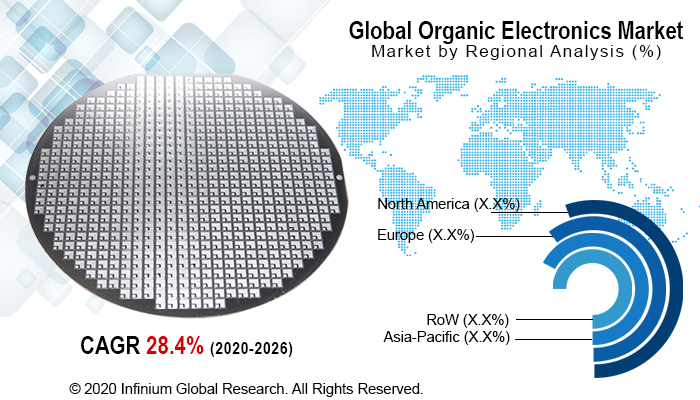
the global organic electronics market is projected to grow at a CAGR of 28.4%
over the forecast period of 2020-2026.
Organic electronics are a novel class of electronics, beneficial
for high-performance devices in major application areas such as displays, lighting,
photovoltaic, and integrated smart systems. These materials are composed of
carbon-based polymers hence recognized as polymer electronics or plastic
electronics. As compared to inorganic electronics, organic electronics offers
the assistance of low-cost manufacturing. It offers better resource utilization
and environment-friendly nature. Several kinds of materials are used in the
manufacturing of organic electronics for instance carbon-based molecular
structures, polymers, hybrid materials, nanotubes, and graphenes. The most
general application of organic materials is an organic light-emitting diode
(OLED) which is mostly used in smartphones. Organic electronics are managed at
room temperature and can be created in bulk at a low cost.
Organic electronics are used in numerous applications such as
photovoltaic, OLED lighting, ORFID, and others. It helps in reducing power
consumption, cost, and weight of electronic goods consequently pouring the
global organic electronics market. Millions of tablets, TV sets, smartphones,
and PCs are being exported internationally thus nurturing the organic
electronics market growth. Likewise, the demand for other organic electronic
goods may heighten in sectors such as government, healthcare, and others. On
the other hand, lack of robustness and non-compatibility with conventional
electronic goods are factors that hamper the global market growth to some
extent. The electronics devices market comprising
consumer electronics and industrial electronics devices is anticipated to be
impacted suggestively by the COVID-19 outbreak since China is one of the major
suppliers for the raw materials (used to manufacture devices) along with the
finished products. The industry is on the edge of facing a reduction in
production, disruption in supply, and price variations. While this can
massively encourage local manufacturers to step up and address the increasing
demand, the shortage of raw material can still pose a challenge to this
industry. The sales of prominent electronic vendors are anticipated to be
affected in the near future.
Among the geographies, North America region is expected to hold
the largest share in the global organic electronics market as countries such as
the U.S. and Canada are the front-runners of the adoption of new technologies.
The North America region is characterized by the presence of several research
universities, which are involved in research projects with subjects associated
with the technology. However, the Asia Pacific region would dominate the industry
in terms of revenue by the end of the forecast period owing to the increasing
adoption of organic electronics technology in consumer product applications.
The Asia Pacific region is expected to be an emerging market, growing at the
fastest CAGR on account of the flourishing electronic manufacturing sector.
The report on the global organic electronics market covers segments
such as material, and application. On the basis of material, the sub-markets
include semiconductor, conductive, dielectric, and substrate. On the basis of
application, the sub-markets include battery, conductive ink, display,
lighting, logic/memory, sensor, OPV, ORFID, and others.
The report provides profiles of the companies in the market such
as Fujifilm Dimatix, Inc., Bayer Materialscience AG, H.C. STARCK, AGC Seimi
Chemical Co., Ltd., Sumitomo, Polyic, Heliatek, Novaled, Merck KgaA, and BASF
Materialscience AG.
The report provides deep insights into the demand forecasts,
market trends, and micro and macro indicators. In addition, this report
provides insights into the factors that are driving and restraining the growth
in this market. Moreover, The IGR-Growth Matrix analysis given in the report
brings an insight into the investment areas that existing or new market players
can consider. The report provides insights into the market using analytical
tools such as Porter's five forces analysis and DRO analysis of the organic
electronics market. Moreover, the study highlights current market trends and
provides forecast from 2020-2026. We also have highlighted future trends in the
market that will affect the demand during the forecast period. Moreover, the
competitive analysis given in each regional market brings an insight into the
market share of the leading players.