
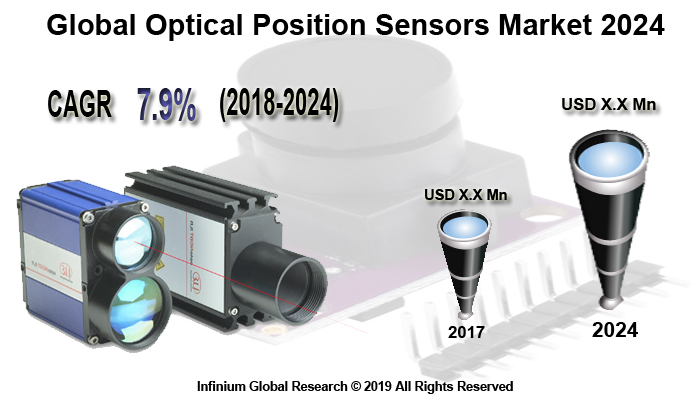
A recent report published by Infinium Global Research on optical position sensors market provides an in-depth analysis of segments and sub-segments in the global as well as regional optical position sensors market. The study also highlights the impact of drivers, restraints, and macro indicators on the global and regional optical position sensors market over the short term as well as long term. The report is a comprehensive presentation of trends, forecast and dollar values of global optical position sensors market. According to the report, the global optical position sensors market is projected to grow at a CAGR of 7.9% over the forecast period of 2018-2024.
The optical position sensor is a device used for determining
the distance traveled by a body starting from its reference point. The key
purpose of the optical sensor is to measure the physical quantity of light
depending upon the type of sensor. Optical Sensors are used for contact-less
detection, counting or positioning of parts. Position sensors are used in a
wide variety of industrial and commercial applications, from high-end military
and defense applications through to low cost automotive and consumer
appliances. The different types of optical sensors include light sensors,
photoelectric sensors, image sensors, infrared detectors, motion sensors,
position sensors and many more. Some of the major applications of position
sensors include a drive by wire cars, injection molding machines, bullet train
taking curves and packaging machines.
Growing applications of optical position sensors in the
automotive industry are the major factor driving the growth of the optical
position sensors market. In the automotive industry, the optical position
sensors are used to sense the position of pedals, steering wheels, various
valves, seat position, and actuators. Moreover, the optical position sensors
are being actively used to detect the position of the vehicle and act as
parking assistance. In addition, these sensors are used to identify the
position of the driver in case of an accident and release the airbags
accordingly. Technological advancements and ongoing innovations in the field of
electronics to reduce the size of the chipset is anticipated to contribute
significant growth towards the optical position sensor market. Furthermore,
rising demand for handheld devices such as smartphones and tablets and gesture
recognition makes optical position sensors technology more popular among mobile
device manufacturers and users. However, the dearth of international standards
to determine the performance of the sensors are likely to curtail the growth of
the optical position sensor market. Emerging concepts of virtual reality and
wearable medical device for remote monitoring of the patients are anticipated
to create several growth opportunities for the key players in the optical
position sensors market.
Among the geographies, North America dominated the optical position sensors market followed by Europe. The growth in the North American regions is due to ongoing technological innovations in the semiconductor industry. Increasing anxieties of drivers concerning vehicle safety are expected to drive the market for optical position sensors in the automotive industry in Europe. The fluctuating government laws in Europe and North America is safeguarding the need for enhanced safety in automobiles. Moreover, the robust development of the manufacturing sector and a tremendous appetite for new machine tools in the Chinese market are expected to boost regional growth over the next seven years.
Segment Covered
The report on global optical position sensors market covers segments such as end user. On the basis of an end user, the sub-markets include automotive, consumer electronics, healthcare, aerospace & defense, and others.
Companies Profiled:
The report provides profiles of the companies in the market such as First Sensors AG, Sharp Corporation, Micro-Epsilon, Sensata Technologies, Hamamatsu Photonics K.K., Opto Diode Corporation, Panasonic Corporation, Balluff GmbH, Siemens AG, and Melexis N.V.
Report Highlights:
The report provides deep insights into the demand forecasts, market trends, and micro and macro indicators. In addition, this report provides insights into the factors that are driving and restraining the growth in this market. Moreover, The IGR-Growth Matrix analysis given in the report brings an insight into the investment areas that existing or new market players can consider. The report provides insights into the market using analytical tools such as Porter's five forces analysis and DRO analysis of optical position sensors market. Moreover, the study highlights current market trends and provides forecast from 2018-2024. We also have highlighted future trends in the market that will affect the demand during the forecast period. Moreover, the competitive analysis given in each regional market brings an insight into the market share of the leading players.