A recent
report published by Infinium Global Research on medical device security market
provides in-depth analysis of segments and sub-segments in the global as well
as regional medical device security market. The study also highlights the
impact of drivers, restraints, and macro indicators on the global and regional
medical device security market over the short term as well as long term. The
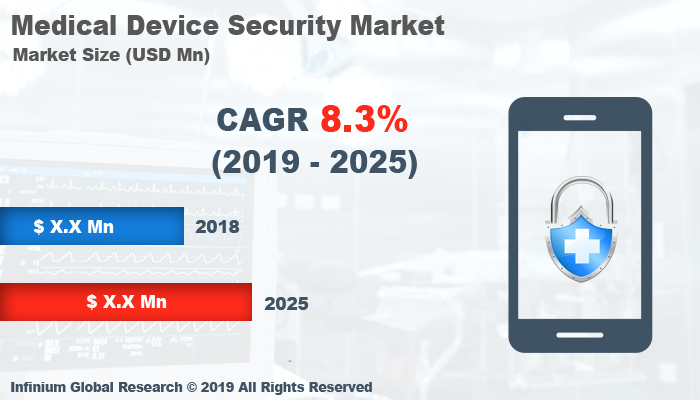
report is a comprehensive presentation of trends, forecast and dollar values of the global medical device security market. According to the report, the global medical
device security market is projected to grow at a CAGR of 8.3% over the forecast
period of 2019-2025.
The growing
use of technologically advanced devices in the medical and healthcare field has
also led to a new hostile environment for such devices, which presents a
serious threat to the security of these devices. The medical devices are now
prone to the cyber-attacks and theft of patient’s personal data which are
critical for the privacy of the patients. Several governments have stepped in
and implemented strict guidelines with the help of organizations including the
FDA and NIST. Today, many medical device end-points are internet connected.
These end-points are more likely to be hacked. The end-point security has
become more important in order to protect the data and the system from
unauthorized access.
Factors
including growing incidences of cyber-attacks and security breaches on medical
devices and the rise in the penetration of interconnected medical devices are
the key drivers for the global medical device security market. Moreover, the
increase in the geriatric population and rise in the prevalence of chronic
diseases globally have increased the demand for sophisticated medical devices,
which contributes to the growth of the medical device security market.
Furthermore, stringent government regulations and the need for compliance are
propelling the growth of the market. However, the low healthcare budget and
lack of security infrastructure are some of the factors that are hampering the
growth of the global medical device security market. Though, the technological
advancements including the development of cloud-based security solutions and
the sensor-based medical devices are anticipated to increase the demand for
medical device security in the future.
By geography,
the global medical device security market is divided into four regions
including North America, Europe, Asia-Pacific inclusive of Australia and the
Rest of the World. North America is leading among the other regions in the global
medical device security market, attributing to the largest share in the market.
The large share of the North America market is due to the rise in the number of
cyber-attacks on medical devices, an increase in awareness among healthcare
professionals about cybersecurity and a rise in government initiatives for
improving cybersecurity. While the Asia-Pacific medical device security market
has registered the fastest growth rate. The high growth rate of the market
attributes to the growing demand for connected medical devices, improving
healthcare infrastructure and raising awareness regarding medical device
security and security of patient health information (PHI) due to the increasing
instances of cyber-attacks.
The report on
global medical device security market covers segments such as component, device
type, and end-user. On the basis of component, the sub-markets include
solutions, and services. On the basis of device type, the sub-markets include
hospital medical devices, embedded medical devices, and wearable medical
devices. On the basis of end-user, the sub-markets include hospitals &
clinics, medical device manufacturers, and other end-users.
The report
provides profiles of the companies in the market such as Cisco Systems, Inc.,
GE Healthcare, Symantec Corporation, International Business Machines (IBM)
Corporation, CA Technologies, Inc., Koninklijke Philips N.V., Check Point
Software Technologies Ltd., McAfee, LLC, Palo Alto Networks, Inc., Sophos Group
plc, and Zscaler, Inc.