
A recent report published by
Infinium Global Research on the industrial cyber security market provides in-depth
analysis of segments and sub-segments in the global as well as regional
industrial cyber security market. The study also highlights the impact of
drivers, restraints, and macro indicators on the global and regional industrial
cyber security market over the short term as well as long term. The report is a
comprehensive presentation of trends, forecast and dollar values of the global
industrial cyber security market. According to the report, the global
industrial cyber security market is projected to grow at a CAGR of 8.7% over
the forecast period of 2020-2026.
Advancements in technology and
development in information technology has transformed several industries.
However, the devices and the data stored on the devices are prone to
cyber-attacks, which makes the organizations more vulnerable to data breaches.
Industrial cybersecurity provides protection for network and data against
cyber-attacks. Security concern has become an important aspect of the
information technology (IT) and operational technology (OT) environment. The
integrated hardware and software are intended to monitor and control several
operations in the industry. Digitization has increased the risk of
cyber-attacks and the need for cyber security in the industrial environment.
Industrial cyber security improves information security, organization's
credentials, and data. Furthermore, it provides faster recovery in case of a
data breach.
The demand for industrial
cybersecurity declined during the pandemic. Many end-users of industrial
cybersecurity have either registered lower revenues or have stopped their
business operations during the pandemic. Lockdown orders by the governments of
many countries have compelled several organizations in various industries to
reduce or close their business operations, reducing the revenue of the
organizations. Furthermore, the global economy has been hit hard by the COVID19
pandemic leading to growing unemployment and lowered incomes. Weak economic
conditions discouraged organizations to spend on non-essential products and
services and save money on essential goods and services. This, in turn, has
hampered the demand for industrial cybersecurity over a short term.
The industrial cyber security
market is majorly driven by the increasing concern regarding data security. The
increased use of internet-based technologies and solutions has amplified the
risk of data theft and concern for data privacy. Furthermore, government
regulation on data security, increasing cyber threats, and growing data centers
are fueling the market. Moreover, the emergence of technologies in cyber
security is propelling the growth of the market. The technologies include
cloud, bring your own device (BYOD) and wireless technologies are boosting the market
growth. The major restraint for the market is the lack of professionals with IT
skills. The cyber security solutions are developed by skilled IT professionals. The lack of such skilled professionals acts as an obstacle for companies to develop
innovative cyber security solutions. The establishment of advanced technologies
in the industrial environment is expected to propel the market growth. The
emergence of the Industrial Internet of Things (IoT), Industry 4.0, and
cloud-based services are projected to boost the market. These technologies
include databases, servers, storage, and software applications. Moreover, this
advancement in technologies projected to reduce cyber-attacks and provide
effective industrial cyber security solutions.
In terms of region, North America
generated the largest revenue in the global industrial cybersecurity market.
The increasing cases of cyber theft and the adoption of advanced technologies
are boosting the demand for the industrial cybersecurity market. Moreover, the
increased spending by the private and public sectors on developing
cybersecurity solutions is anticipated to drive the market further. On the
other hand, the Asia Pacific region is projected to grow at the fastest rate in
the global industrial cybersecurity market. The increasing digitization and
concern for data security are propelling the growth of the market in this
region. Additionally, the European region predicted a promising growth of the
industrial cyber security market owing to the higher adoption of automation and
higher industrialization.
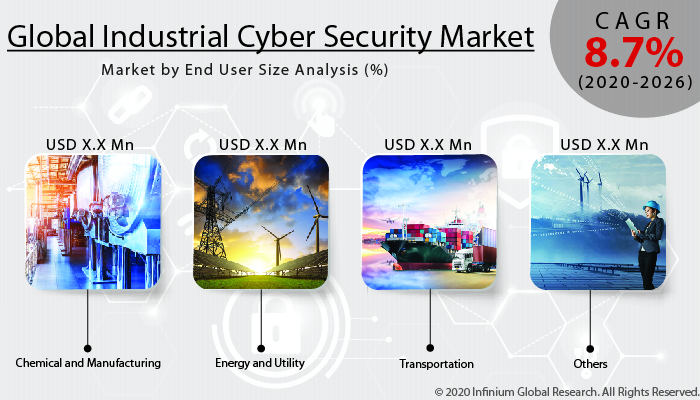
The report on the global industrial
cyber security market covers segments such as component, security type,
organization size, and end user. On the basis of component, the sub-markets
include hardware, software, and service. On the basis of security type, the
sub-markets include network security, cloud security, end-point security,
application security, and others. On the basis of organization size, the
sub-markets include small and medium scale enterprise, and large scale
enterprise. On the basis of end user, the sub-markets include chemical and
manufacturing, energy and utility, transportation, and others.
The report provides profiles of
the companies in the market such as International Business Machines
Corporation, Honeywell International Inc, ABB Ltd, Cisco Systems, Inc.,
Schneider Electric SE, Rockwell Automation, Inc., Dell Inc., McAfee, LLC,
Symantec Corporation, and Kaspersky Lab.
The report provides deep insights
into the demand forecasts, market trends, and micro and macro indicators. In
addition, this report provides insights into the factors that are driving and
restraining the growth in this market. Moreover, The IGR-Growth Matrix analysis
given in the report brings an insight into the investment areas that existing
or new market players can consider. The report provides insights into the
market using analytical tools such as Porter's five forces analysis and DRO
analysis of industrial cyber security market. Moreover, the study highlights
current market trends and provides forecast from 2020-2026. We also have
highlighted future trends in the market that will affect the demand during the
forecast period. Moreover, the competitive analysis given in each regional
market brings an insight into the market share of the leading players.