
Artificial intelligence simplifies
the lives of patients, doctors, and hospital administrators by performing tasks
in less time and at a fraction of the cost that is typically done by humans. A
Digital Assistant called Conversational AI Interfaces can speak different languages
and can be controlled via voice or text messages. It helps to handle the user
input and is able to memorize and process the data for self-learning. It is
finding great applications in providing emotional support to patients. For
example, Woebot, uses the principles of cognitive-behavioral therapy (CBT) and
applies clinical approaches to help patients with anxiety and depression.
The outbreak of coronavirus over
the world is the major driving factor for the global digital assistants in the
healthcare market. The factors such as the growing requirement for automation
and the increasing number of users with smart devices are also driving the
demand for global digital assistants in the healthcare market. Leading
smartphones and wearable manufacturers like Samsung, Apple, Huawei, and Fitbit
are using AI in smartphones and smart wearable’s to enhance the patient's
experience in the healthcare sector. The use of mobile devices by health care
professionals (HCPs) has transformed many aspects of clinical practice and it
has become commonplace in health care settings. Smartphones are leading to
rapid growth in the development of medical software applications (apps) for
these platforms. The COVID-19 infection has impelled lockdown measures that
caused huge disruption to carry out business across the automotive industry.
However, the company’s strategy to stop the progress of investment and
progression towards novel technologies in a bid to save cost has massively
impacted the growth of future mobility solutions such as digital assistants in
healthcare. Furthermore, product development cycles and new model launches are
delayed due to financial challenges and supply chain disruptions.
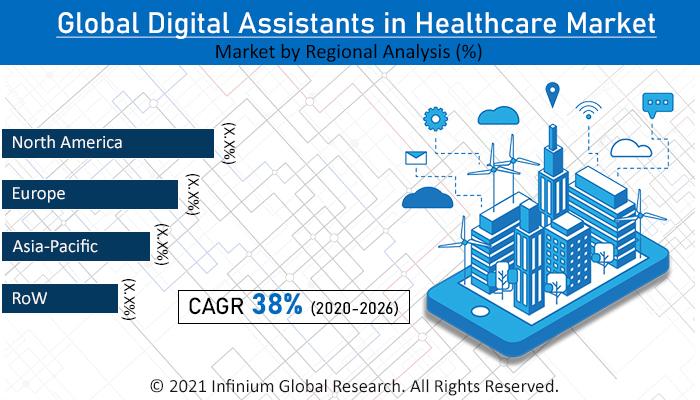
Among the regions, North America
is dominating the global digital assistants in the healthcare market followed
by Europe. The presence of original equipment manufacturers, advanced
technology, in large numbers, and a strong customer base are the major factors
responsible for the growth of the North America region. North America’s contributions
to self-driving are fueled heavily by tech hubs on the west coast of the United
States as an industry leader in the automated vehicle space. Furthermore, the
European Union (EU) has recognized the benefits that digital assistants in
healthcare can provide and is leading the way to ensure cooperation at a
regional level among all stakeholders, creating an environment favorable to
digital assistants in healthcare development.
The report on global digital
assistants in healthcare market covers segments such as product, application,
and end user. On the basis of product, the sub-markets include smart speakers,
and chatbots. On the basis of application, the sub-markets include patient
tracking, medical reference, diagnostic guides, drug dosage, medical
calculators, nursing reference, and others. On the basis of end user, the
sub-markets include hospitals & clinics, ambulatory surgical centers, and
others.
The report provides profiles of
the companies in the market such as Nuance Communications Inc, Microsoft
Corporation, Amazon, Kognito Solutions LLC, Verint Systems Inc, HealthTap Inc,
Babylon Healthcare Services Ltd, Infermedic, Sensly, Inc, eGain Corporation,
and CSS Corporation.
The report provides deep insights
into the demand forecasts, market trends, and micro and macro indicators. In
addition, this report provides insights into the factors that are driving and
restraining the growth in this market. Moreover, The IGR-Growth Matrix analysis
given in the report brings an insight into the investment areas that existing
or new market players can consider. The report provides insights into the
market using analytical tools such as Porter's five forces analysis and DRO
analysis of digital assistants in healthcare market. Moreover, the study
highlights current market trends and provides forecast from 2020-2026. We also
have highlighted future trends in the market that will affect the demand during
the forecast period. Moreover, the competitive analysis given in each regional
market brings an insight into the market share of the leading players.