
A recent report published by
Infinium Global Research on the dark analytics market provides an in-depth analysis of
segments and sub-segments in the global as well as regional dark analytics
market. The study also highlights the impact of drivers, restraints, and macro
indicators on the global and regional dark analytics market over the short term
as well as long term. The report is a comprehensive presentation of trends,
forecast and dollar values of the global dark analytics market. According to the
report, the global dark analytics market was nearly worth USD 430 Million in
2020 and the market will roughly be equating to 1000 Million by 2026, growing
with a CAGR of 21.3% during the forecast period of 2020-2026.
Dark analytics focuses mainly on
raw text-based unstructured data that has not been tapped or analyzed before.
The data includes text messages, emails, audios, videos, images, etc. Further
dark analysis can also target the deep web, which comprises everything on the
internet not indexed by search engines, including a small part of inaccessible
sites, called the dark web. Customer information, log files, a previous employee
information, raw survey data, financial statement, account information are some
examples of unstructured data that are considered dark data.
The adoption of artificial
intelligence and machine learning for dark data analysis is driving the market
growth. Drawing on new advances in artificial intelligence and machine learning
to produce technology that will help automate each stage of the data analytics
process. This technology will revolutionize the speed and efficiency with which
data can be transformed into useful knowledge. Growth in data generated by
organizations worldwide is also driving the market growth. Data are quickly
becoming a new form of capital, a different coin, and an innovative source of
value. Data generated by governmental organizations are internally fragmented
and opaque to citizens and businesses. The factor such as extracting insights
for decision making by immediate analysis of real-time information from key
business processes such as sales, production, and distribution trends is
fueling the market growth. However, risks associated with data, and data
storage costs are some factors hampering the growth of the dark analytics
market. Dark data is just a small portion of an incredibly larger deep web.
Hence, from a cyber-risk perspective, the risks are likely to be magnified.
Moreover, increasing investments in dark analytics technology by SMEs provide
growth opportunities to the market players. The demand for dark analytics has
significantly grown in the last few years as it helps in reducing the
accumulation or growth of dark or unstructured data. It also aids in reducing
the time used for processing unstructured data and helps in using resources and
money efficiently.
The effects of COVID-19 have been
quick and substantial on global dark analytics. The pandemic has resulted in
being a major disrupter, shifting the global dynamics. Many of the models used
for segmentation or forecasting started to fail when traffic and shopping
patterns changed, supply chains were interrupted, and borders were locked down.
Manufacturing companies around the world are now focusing on developing plans
to reduce the aftershocks of this pandemic. The pandemic has led to large-scale
distress to supply bases, assembly plant closures, and further downshift to the
declining consumer demand.
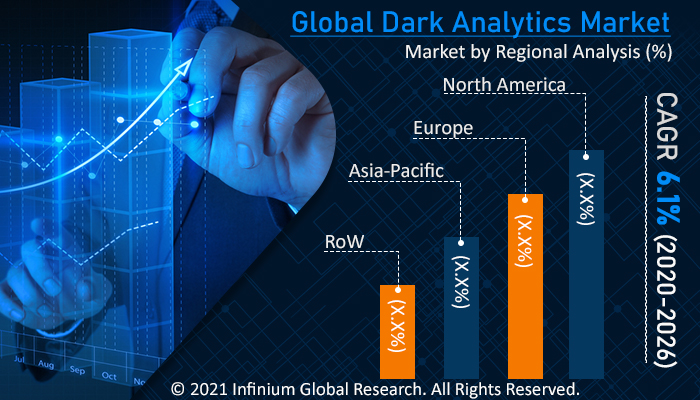
The North American region
accounted for the largest market share of the global dark analytics market. This
region is identified as the major adopter of emerging technologies such as big
data analytics, IoT, and BI tools. The Asia Pacific and European regions have
the fastest-growing market for dark analytics. The growing adoption of
cloud-based enterprise applications and growing technological advancement are
influencing the market growth in the Asia Pacific and Europe regions.
Furthermore, the increasing amount of data, investments in the market and
rising penetration of the internet is propelling the market growth in these
regions.
The report on the global dark
analytics market covers segments such as component, deployment mode, and
vertical. On the basis of component, the sub-markets include solutions, and
services. On the basis of deployment mode, the sub-markets include cloud, and
on-premises. On the basis of vertical, the sub-markets include retail &
e-commerce, BFSI, healthcare, travel & hospitality, government,
telecommunication, and others.
The report provides profiles of
the companies in the market such as SAP SE, IBM Corporation, Symantec, Amazon
Web Services, Micro Focus, Dell EMC, Microsoft, Teradata, Datameer, and
AvePoint.
The report provides deep insights
into the demand forecasts, market trends, and micro and macro indicators. In
addition, this report provides insights into the factors that are driving and
restraining the growth in this market. Moreover, The IGR-Growth Matrix analysis
given in the report brings an insight into the investment areas that existing
or new market players can consider. The report provides insights into the
market using analytical tools such as Porter's five forces analysis and DRO
analysis of dark analytics market. Moreover, the study highlights current
market trends and provides forecast from 2020-2026. We also have highlighted
future trends in the market that will affect the demand during the forecast
period. Moreover, the competitive analysis given in each regional market brings
an insight into the market share of the leading players.