
A recent report published by
Infinium Global Research on brain computer interface market provides in-depth
analysis of segments and sub-segments in the global as well as regional brain
computer interface market. The study also highlights the impact of drivers,
restraints, and macro indicators on the global and regional brain computer
interface market over the short term as well as long term. The report is a
comprehensive presentation of trends, forecast, and dollar values of the global
brain computer interface market. According to the report, the global brain
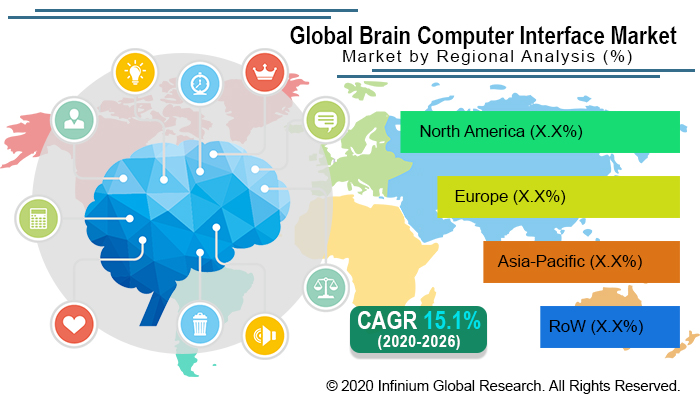
computer interface market is projected to grow at a CAGR of 15.1% over the
forecast period of 2020-2026.
Brain computer interface (BCI)
obtain brain signals, analyze them, and translate them into commands that are
communicated to output devices that carry out desired actions. Brain computer
interfaces do not use normal neuromuscular output pathways. Further, its
foremost goal is to replace or restore useful function to people disabled by
neuromuscular disorders, for example, amyotrophic lateral sclerosis, cerebral
palsy, stroke, or spinal cord injury. Brain computer interfaces may also prove
beneficial for rehabilitation after stroke and for other disorders.
Major drivers of the brain computer interface market include increasing prevalence of neuroprosthetic conditions,
rising geriatric population, and increasing technological developments
facilitating communication and movement in paralytic patients. In addition, the
use of brain computer interface technology in virtual gaming, home control
systems, and military communication enhances the applicability of brain
computer interface systems, thereby fuelling its growth. Moreover, the
increasing prevalence of neurodegenerative disorders such as Alzheimer’s and
Parkinson’s disease and epilepsy are anticipated to drive the demand for brain
computer interface over the forecast period. Conversely, ethical problems faced
during research and cybersecurity threats are expected to hamper the brain computer
interface market growth. On the contrary, integration of AI with brain computer
interface, and a rise in demand for brain computer interface by SMEs provide
lucrative growth opportunities for the global market over the analysis period. Additionally,
the current concern over the spread of coronavirus is also expected to have a
negative impact on the brain computer interface market for the short term. The
spread of COVID-19 cases is likely to affect the medical product supply chain
resulting in the shortage of critical medical devices. Due to the current
epidemic, the medical device industry has been under tremendous pressure to
provide new products. With COVID-19 pandemic infections swelling across the
globe, the anxiety regarding a scarcity of essential life-saving devices and
other essential medical supplies in order to prevent the spread of this
epidemic and provide prime care to the infected also widens. However, as
several countries are planning to start re-opening of the economy, most
countries will allow elective medical procedures to resume. This move will
gradually improve the business of the brain computer interface over the long
term.
Among the geographies, North
America region is expected to hold the largest share in the global brain
computer interfaces market as countries such as the U.S. and Canada are the
front-runners of the adoption of technology-based medical equipment. Further,
the increasing investment for developing advanced healthcare solutions,
increasing R & D initiatives from the educational sector, and expanding
research laboratories focused on brain computer interface (BCI) development are
the factors driving the market growth in the North America region. Moreover,
the Asia pacific brain computer interface market is identified as the
fastest-growing market during the forecast period, owing to a continuous focus
on sensor-based technologies and continuous adaptation to advanced healthcare
solution.
The report on the global brain
computer interface market covers segments such as type and application. On the
basis of type, the sub-markets include invasive BCI, non-invasive BCI, and
partially invasive BCI. On the basis of application, the sub-markets include
communication & control, healthcare, smart home control, entertainment
& gaming, and others.
The report provides profiles of
the companies in the market such as Mind Technologies Inc, Covidien, PLC,
Compumedics, Ltd., Natus Medical, Inc., Nihon Kohden Corporation, Integra Life
Sciences Corporation, CAS Medical Systems, Advanced Brain Monitoring Inc.,
Iwinks, and InteraXon.
The report provides deep insights
into the demand forecasts, market trends, and micro and macro indicators. In
addition, this report provides insights into the factors that are driving and
restraining the growth in this market. Moreover, The IGR-Growth Matrix analysis
given in the report brings an insight into the investment areas that existing
or new market players can consider. The report provides insights into the
market using analytical tools such as Porter's five forces analysis and DRO
analysis of brain computer interface market. Moreover, the study highlights
current market trends and provides forecast from 2020-2026. We also have
highlighted future trends in the market that will affect the demand during the
forecast period. Moreover, the competitive analysis given in each regional
market brings an insight into the market share of the leading players.