
A recent report published by
Infinium Global Research on the aviation IoT market provides an in-depth
analysis of segments and sub-segments in the global as well as regional
aviation IoT market. The study also highlights the impact of drivers,
restraints, and macro indicators on the global and regional aviation IoT market
over the short term as well as long term. The report is a comprehensive
presentation of trends, forecast, and dollar values of the global aviation IoT
market. According to the report, the global aviation IoT market is projected to
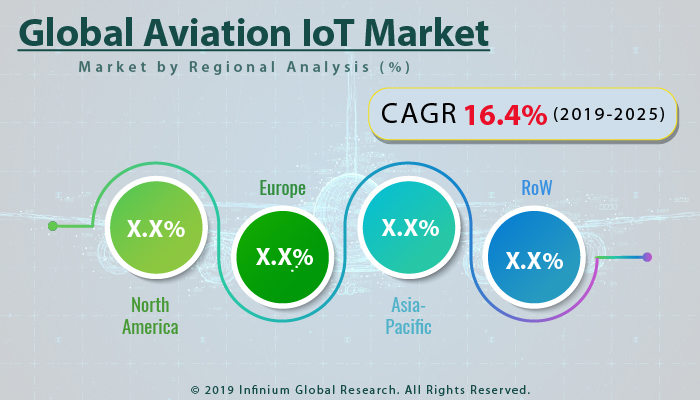
grow at a CAGR of 16.4% over the forecast period of 2019-2025.
IoT can connect all the devices
and processes. Aviation IoT makes the travel experience simple and better. It
is a better form of connection wherein the airport assets and the sensors are
integrated at once. IoT is enabled in F-35 jet aviation and mandated by the
Pentagon. It will be tested in all F-35 jets to estimate its capability in cold
weather carrier operation, missions. Data is collected by IoT, which helps F-35
jet to get complete information on combat mission’s related ships, ground
troops, on and others in between. The main objective of these tests is to solve
many problems it was facing over the past decades. The use of IoT is expanding
day by day with the increase of users having smart devices at airports.
Aviation reliability, quality, customer satisfaction, and fuel efficiency in an
industry have been enhanced using IoT. In the coming years, it is expected to
grow extensively.
Increasing adoption of In-flight
Amusement (IFE) Systems is the factor driving the aviation IoT market. The
benefits of IoT including better correspondence conditions and enhance
operational productivity are boosting the aviation IoT market. An increase in
demand for the assistive technologies for physically challenged travelers is
thrusting the aviation IoT market. The increasing demand for cloud-based IoT
services and solutions is enhancing the aviation IoT market. The increasing
investment in smart airport concept is the factor impelling the aviation IoT
market. The increasing demand of connected electronic flight bags and
connectivity devices that need help from advanced data capture frameworks is
propelling the aviation market. However, high deployment costs and complexities
with interoperability are the major factors hampering the aviation IoT market.
Moreover, the lack of regularization in the IoT industry is the factor
hindering the aviation IoT market. The development of in-flight tracking
systems offers favorable opportunities in the aviation IoT market.
Geographically, North America is the dominant region in the aviation IoT market. Increasing demand for the IoT in the aerospace tools is the factor driving the aviation IoT market in North America. Europe holds the second largest market share in the aviation IoT market. Asia-Pacific is expected to grow at a maximum CAGR in the forecast period. The rise in the deployment of assistive technologies coupled with increasing investment in in-flight connective solutions is the factor propelling the aviation IoT market.
The report on the global aviation
IoT market covers segments such as application, end-user, and component. On the
basis of application, the sub-markets include the IoT industry for passengers
and the IoT industry for aircraft operations. On the basis of end-user, the
sub-markets include aircraft, airport, airlines, MRO service providers, and
military command center. On the basis of component, the sub-markets include
communication services, data center systems, devices, and software.
The report provides profiles of
the companies in the market such as Cisco Systems, Inc., Huawei Technologies
Co. Ltd., International Business Machine Corporation, Accenture plc, Amadeus IT
Group SA, SAP SE, Living PlanIT AG, Microsoft Corporation, Wind River Systems,
Inc., and Other Companies.
The report provides deep insights
into the demand forecasts, market trends, and micro and macro indicators. In
addition, this report provides insights into the factors that are driving and
restraining the growth in this market. Moreover, The IGR-Growth Matrix analysis
given in the report brings an insight into the investment areas that existing
or new market players can consider. The report provides insights into the
market using analytical tools such as Porter's five forces analysis and DRO
analysis of aviation IoT market. Moreover, the study highlights current market
trends and provides forecast from 2019-2025. We also have highlighted future
trends in the market that will affect the demand during the forecast period.
Moreover, the competitive analysis given in each regional market brings an
insight into the market share of the leading players.