
A recent report published by Infinium Global Research on allergy
immunotherapy market provides an in-depth analysis of segments and sub-segments in
the global as well as regional allergy immunotherapy market. The study also
highlights the impact of drivers, restraints, and macro indicators on the
global and regional allergy immunotherapy market over the short term as well as
long term. The report is a comprehensive presentation of trends, forecast and
dollar values of global allergy immunotherapy market. According to the report,
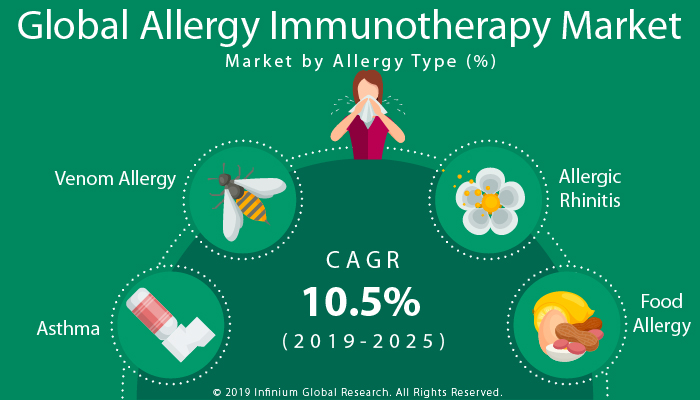
the global allergy immunotherapy market is projected to grow at a CAGR of 10.5%
over the forecast period of 2019-2025.
AIT (Allergy Immunotherapy), is referred to as desensitization, it
is the only treatment therapy that targets the cause of allergy. According to
the WAO (World Allergy Organization), around 10%-40% of the total population of
the world in 2013 is suffering from various allergy. AIT is a treatment option
for asthma and environmental allergies. It is an ultimate goal to influence the
immune system and its natural regulation through complex mechanisms.
The global allergy immunotherapy market is primarily driven by the
rising consciousness of the patient's concern to the allergy treatment.
Moreover, the development of novel products and the growing number of allergic
patients is expected to fuel market growth in the near future. However, the
allergy tablets are able to heal only a particular type of allergen and remain
inefficient to avert the progress of asthma and new allergies are expected to
hinder the demand for the global allergy immunotherapy market. Nonetheless,
increasing awareness among Patients for allergies is anticipated to create a
new opportunity for the global allergy immunotherapy market.
On the basis of region, the global allergy immunotherapy market is
bifurcated into North America, Asia Pacific, Europe, Latin America, and the
Middle East and Africa. Europe has held the largest revenue share of the global
allergy immunotherapy market in 2018 and it is expected to be the dominating
region in the coming years. Owing to rising in funding for research and
development, high awareness, and grants, complimentary medical reimbursement
policies. Europe is a highly influensive market for allergy immunotherapy and
is estimated to grow at a significant growth rate within the projected years.
Promising products of the clinical pipeline, and increasing allergic
population. North America accounted for the second-largest market share for the
global allergy immunotherapy market in 2018.
The report on global allergy immunotherapy market covers segments
such as type, allergy type, and distribution channel. On the basis of type, the
sub-markets include SLIT, and SCIT. On the basis of allergy type, the
sub-markets include asthma, venom allergy, allergic rhinitis, food allergy, and
others allergy type. On the basis of distribution channel, the sub-markets
include retail pharmacy and drug stores, hospital pharmacy, and online
pharmacy.
The report provides profiles of the companies in the market such
as Aimmune Therapeutics, Biomay, Stallergenes Greer, Abello, Allergy
Therapeutics, Merck, Circassia, HAL Allergy, Anergis, and DBV Technologies.
The report provides deep insights into the demand forecasts, market trends, and micro and macro indicators. In addition, this report provides insights into the factors that are driving and restraining the growth in this market. Moreover, The IGR-Growth Matrix analysis given in the report brings an insight into the investment areas that existing or new market players can consider. The report provides insights into the market using analytical tools such as Porter's five forces analysis and DRO analysis of allergy immunotherapy market. Moreover, the study highlights current market trends and provides forecast from 2019-2025. We also have highlighted future trends in the market that will affect the demand during the forecast period. Moreover, the competitive analysis given in each regional market brings an insight into the market share of the leading players.