
A recent report published by Infinium Global Research on AI in manufacturing market provides an in-depth analysis of segments and sub-segments in the global as well as regional AI in manufacturing market. The study also highlights the impact of drivers, restraints, and macro indicators on the global and regional AI in manufacturing market over the short term as well as long term. The report is a comprehensive presentation of trends, forecast, and dollar values of global AI in manufacturing market. According to the report, the global AI in manufacturing market estimates that the market was worth USD 2 billion in 2020 and is projected to reach USD 34.9 billion by 2026, growing with a CAGR of 49.90% over the forecast period of 2020-2026.
Artificial intelligence plays an important role in the manufacturing industries as it offers a more reliable and faster work process than humans. AI has the potential to amplify the effectiveness of manufacturing with enhanced productivity. In addition, artificial intelligence offers speech recognition, learning, planning, and problem-solving capabilities which help the manufacturing companies to provide a safer operational environment that helps to enhance the quantity and quality of the production. On the other side, reluctance for acceptance of artificial intelligence among the manufacturers is expected to restrain the market growth over the forecast period.
Increasing investment in artificial intelligence globally is driving global AI in the manufacturing market. Furthermore, the growing adoption of smart manufacturing factory resolution is fueling the demand for AI in manufacturing. These days, factories are becoming increasingly automated, self-monitoring, and self-correcting as their machines are acquiring the ability to analyze and communicate with each other and their human co-workers. On the other side, the lack of skilled professionals is hampering the market growth. Though the investments in the AI industry are increasing, one of the key challenges is the dearth of skills and experience associated with AI. Moreover, the adoption of automation technologies to curb the effects of COVID-19 is creating opportunities for market players. Large-scale lockdowns, absence of labor force due to transport restrictions, and disruption of the supply chain are likely to drive the automation needs across the manufacturing sector.
Among the regions, North America held the largest share in the global AI in the manufacturing market due to the continued American leadership in AI. The national strategy such as American Artificial Intelligence Initiative continues to make United States leadership in the AI manufacturing sector a top priority. The manufacturing industry in the U.S. will experience an encouraging growth as several manufacturing companies are heavily investing in AI technology to keep inventories lean and reduce the cost. Nonetheless, Asia Pacific's performance in AI in manufacturing is expected to be exceptional due to China’s adoption of the technology in its industrial manufacturing operations. Moreover, the presence of several leading manufacturing industries in India and China such as steel, semiconductor, automobiles, and mining will be a key factor driving the adoption of AI technology in this region.
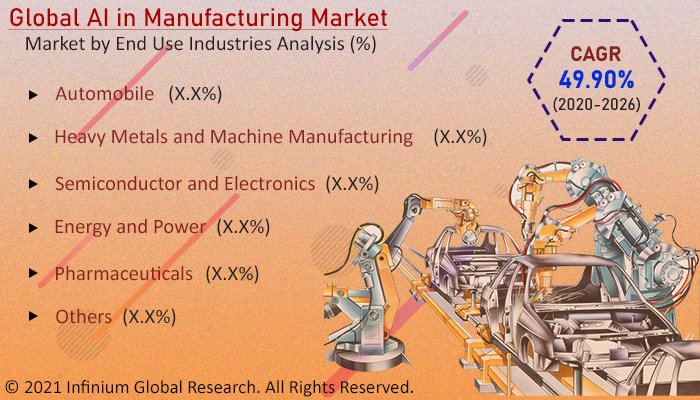
The report on global AI in manufacturing market covers segments such as component, technology, and end use industries. On the basis of component, the sub-markets include hardware, software, and services. On the basis of technology, the sub-markets include text analytics & nlp, machine learning platforms, deep learning, robotic processes automation, machine vision, and others. On the basis of end use industries, the sub-markets include automobile, heavy metals and machine manufacturing, semiconductor and electronics, energy and power, pharmaceuticals, and others.
The report provides profiles of the companies in the market such as Siemens AG, Mitsubishi Electric Corporation, Intel Corporation, NVIDIA Corporation, IBM Corporation, Progress Software Corporation, Rockwell Automation Inc., Cisco Systems Inc., Microsoft Corporation, and Oracle Corporation.
The report provides deep insights into the demand forecasts, market trends, and micro and macro indicators. In addition, this report provides insights into the factors that are driving and restraining the growth in this market. Moreover, The IGR-Growth Matrix analysis given in the report brings an insight into the investment areas that existing or new market players can consider. The report provides insights into the market using analytical tools such as Porter's five forces analysis and DRO analysis of AI in manufacturing market. Moreover, the study highlights current market trends and provides forecast from 2020-2026. We also have highlighted future trends in the market that will affect the demand during the forecast period. Moreover, the competitive analysis given in each regional market brings an insight into the market share of the leading players.