
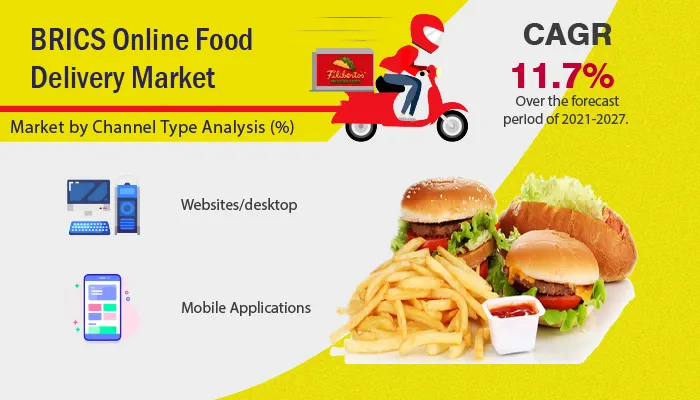
A recent report published by Infinium Global Research on the online food delivery market provides in-depth analysis of segments and sub-segments in the BRICS as well as regional online food delivery market. The study also highlights the impact of drivers, restraints, and macro indicators on the BRICS and regional online food delivery market over the short term as well as long term. The report is a comprehensive presentation of trends, forecast and dollar values of BRICS online food delivery market. According to the report, the BRICS online food delivery market is projected to grow at a CAGR of 11.7% over the forecast period of 2021-2027, growing from more than USD 3261 billion in 2020 to about USD 6581 billion in 2027.
BRICS online food delivery market is expected to grow as a more diverse section of the industry as people start using smartphones besides accessing the internet for ordering food. Today, a number of start-ups are entering into the food business, realizing the long-term benefits associated with food delivery. China has registered the highest growth rate in the food delivery market among other countries in the BRICS. Furthermore, the online food delivery market in countries such as India, Brazil, Russia, and South Africa is also expected to grow significantly over the forecast period.
Online food delivery picked up pace in the last year as the COVID-19 pandemic forced people to stay home. After initial resistance from people about letting delivery executives into their homes, online food delivery companies have ramped up their offerings with contactless orders and more. As food takeout and delivery services flourish, takeaways in India have been rolling out for Chinese investors.
The massive shifts in the lifestyle of modern Indians have created a smooth pathway for the industry of on-demand food delivery apps, with the individuals who set their own working hours, own pace as well as living an independent lifestyle. With an increasing number of young being productively employed in lucrative industries, sectors like IT services have upped the living standards and made their wallets fatter too. Urbanization sees a visible change in the social setting, which further fuels the advance of fast-food restaurants in India. Higher disposable income is also a key driver for the online food delivery market. The changing urban lifestyle is dramatic enough to be favorable for the food-on-the-go and quick home delivery models to grow at higher rates. The ever-increasing population of crowded metro cities and longer travel times are drivers for the online food delivery market.
India holds the largest online food delivery market. With a population of over 1.2 billion, India is undeniably one of the biggest consumer markets in the world today. Moreover, 50% of this population falls under the age of 25, and the rest before the age of 35 years; making India among the youngest population in the world too. Most of the online fast-food demand comes from the age group 18-40 years. India’s young population is one of the key drivers for the demand of the online food delivery market. As food delivery services flourish, takeaways in India have been rolling out the red carpet for Chinese investors.
The report on BRICS online food delivery market covers segments such as service type, channel type, and mode of transaction. On the basis of service type, the sub-markets include restaurant-controlled, independent, food app services, and others. On the basis of channel type, the sub-markets include websites/desktop, and mobile applications. On the basis of mode of transaction, the sub-markets include cash on delivery, and online.
The report provides profiles of the companies in the market such as Zomato Limited, Bundl Technologies Private Limited (Swiggy), Delivery Hero SE (foodpanda), Meituan Inc., ELEME Inc., Movile Group (iFood), Quero Delivery, Mail.ru Group (Delivery Club), Yandex NV, and Mr Delivery (Pty) Ltd..
The report provides deep insights into the demand forecasts, market trends, and micro and macro indicators. In addition, this report provides insights into the factors that are driving and restraining the growth in this market. Moreover, The IGR-Growth Matrix analysis given in the report brings an insight into the investment areas that existing or new market players can consider. The report provides insights into the market using analytical tools such as Porter's five forces analysis and DRO analysis of online food delivery market. Moreover, the study highlights current market trends and provides forecast from 2021-2027. We also have highlighted future trends in the market that will affect the demand during the forecast period. Moreover, the competitive analysis given in each regional market brings an insight into the market share of the leading players.